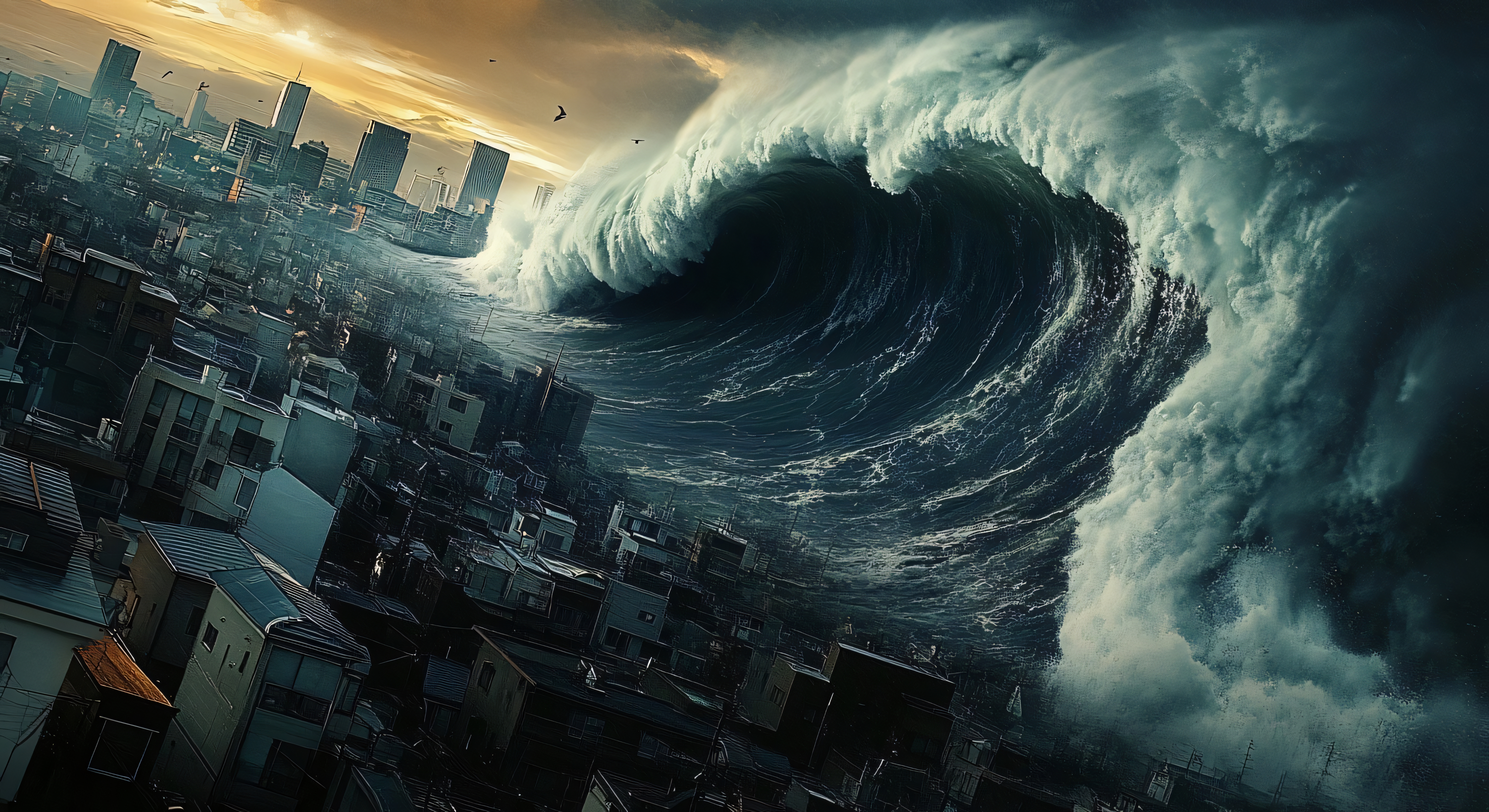
What Is a Tsunami?
A tsunami is not a single breaking wave like a normal surf set. It is a series of long waves, triggered when a large volume of ocean water is suddenly moved. The entire water column shifts, carrying energy across thousands of kilometers.
Most tsunamis are generated by strong undersea earthquakes that cause part of the seafloor to lift or drop. Landslides, volcanic eruptions, and even meteorite impacts can also disturb the ocean enough to trigger a tsunami. In deep water these waves may only rise a few tens of centimeters, but they travel as fast as a jetliner and carry enormous energy toward the coast.
As tsunami waves reach shallow coastal waters around Hawaii, they slow down and grow taller. The water level can rise gradually like a rapidly incoming tide, or surge inland as a series of powerful walls of water. Strong currents and debris often cause more damage than the height of the wave itself.
Why Hawaii Is Especially Vulnerable
Hawaii lies in the middle of the Pacific Ocean, surrounded by active subduction zones along the so-called “Ring of Fire.” Around this ring, tectonic plates collide and dive beneath one another, generating many of the world’s largest earthquakes and tsunamis. Although Hawaii itself does not sit on a major subduction boundary, tsunamis created thousands of kilometers away can still reach the islands.
These distant events, known as teletsunamis, radiate outward from the earthquake source. The open Pacific gives the waves a direct path toward Hawaii. Historic examples include tsunamis from major earthquakes in Alaska, Chile, and Japan that crossed the ocean and caused serious damage once they reached the islands.
Hawaii can also experience locally generated tsunamis. Earthquakes in and around the Hawaiian Islands, undersea landslides on volcanic slopes, or rapid changes during volcanic activity may all disturb the nearby seafloor. These local events leave far less time for warning, which is why natural signs and local preparedness are so important for anyone living near or visiting the coast.
A Brief History of Hawaii Tsunami Events
The written record of tsunamis in Hawaii stretches back to the early 1800s. Historical catalogs and scientific surveys list more than 160 confirmed tsunamis affecting the islands since 1812. Only a small fraction caused loss of life or major destruction, but those that did have left a deep mark on communities, especially on the island of Hawaiʻi.
Some of the most destructive hawaii tsunami events include:
- April 1, 1946 – Aleutian Islands earthquake: A powerful earthquake along the Alaska–Aleutian subduction zone generated a tsunami that struck Hawaii with little warning. Hilo and other coastal areas suffered devastating damage and loss of life, leading to the creation of the Pacific Tsunami Warning Center.
- May 23, 1960 – Chile earthquake: A magnitude 9.5 earthquake off the coast of Chile produced a Pacific-wide tsunami. When the waves reached Hawaii, they caused significant flooding and damage, again hitting Hilo especially hard.
- March 28, 1964 – Alaska earthquake: Another megathrust earthquake in Alaska sent waves around the Pacific, including toward Hawaii. While damage in Hawaii was less severe than in 1946 or 1960, the event reinforced the ongoing risk from large, distant earthquakes.
- November 29, 1975 – Kalapana local tsunami: A strong earthquake near the south coast of Hawaiʻi Island and a partial collapse of the volcanic slope generated a local tsunami. Waves up to several meters high struck the nearby coast only minutes after the shaking, illustrating how quickly locally generated tsunamis can arrive.
- March 11, 2011 – Tōhoku, Japan earthquake: The catastrophic earthquake and tsunami in Japan also sent waves across the Pacific. In Hawaii, harbors and coastal infrastructure were damaged, with tens of millions of dollars in losses, even though wave heights were much smaller than in Japan.
Over time, each serious hawaii tsunami has driven improvements in warning technology, evacuation maps, and public education. The experience of communities like Hilo, sometimes called the “tsunami capital” because of its exposure and bay shape, has helped scientists and emergency managers design better protection for the entire state.
How Often Do Tsunamis Affect Hawaii?
Looking at the historical record, Hawaii has experienced more than 160 confirmed tsunamis in just over two centuries. That works out to an average of less than one event per year. Many of these are small, barely noticeable changes in water level recorded only by tide gauges and instruments.
Destructive tsunamis, however, are much less frequent. Only a handful have caused major damage and loss of life. Even so, their impacts have been severe enough that tsunamis remain one of the most serious natural hazards for coastal communities across the islands.
Historical data suggest that:
- Minor or measurable tsunamis reach Hawaii every few years.
- Damaging tsunamis from distant sources occur on the scale of several decades.
- Strong local events are rarer but more dangerous because warning time is short.
Exact timing cannot be predicted, so preparedness is based on long-term patterns rather than specific dates.
Overall, the lesson from the history of hawaii tsunami events is clear: while a major disaster may not happen every year, the risk is constant over time. People who live, work, or travel near the coast benefit from treating tsunamis as an inevitable, if infrequent, part of life in the Pacific.
Types of Tsunami Threats Facing Hawaii
The tsunami hazard in Hawaii can be divided into three main categories, each with its own behavior and warning challenges.
- Distant (teletsunami) sources: These tsunamis are generated by large earthquakes thousands of kilometers away, such as those in Alaska, Chile, Japan, or other parts of the Pacific Ring of Fire. They can take several hours to reach Hawaii, giving scientists time to analyze earthquake data, run forecast models, and issue warnings.
- Local sources: Earthquakes within or very close to the Hawaiian Islands, along with undersea landslides on volcanic slopes, can generate tsunamis that reach nearby shores in minutes. For these, the ground shaking itself is the primary warning sign for people at the coast.
- Regional sources: Earthquakes in the broader central Pacific may not be as far away as Alaska or Chile, but still give more warning time than purely local events. These tsunamis require careful monitoring because their impact depends on both distance and earthquake strength.
Any of these sources can produce waves capable of flooding coastal communities, damaging harbors, and disrupting ecosystems. Even tsunamis that do not reach historic levels can reshape beaches, coral reefs, and wetland habitats around the islands.
What a Hawaii Tsunami Looks and Feels Like
A hawaii tsunami may not always match the dramatic images often seen in movies. In many cases, the first sign is a rapid change in sea level rather than an enormous breaking wave. The ocean may pull back, exposing reef and seafloor that are usually underwater, or it may suddenly surge inland like an extremely fast and powerful tide.
Once the initial wave arrives, more waves usually follow. The time between waves can range from several minutes to over an hour, and later waves are sometimes larger than the first. Strong currents turn floating objects into dangerous debris, and water can flow around buildings or through streets in unpredictable ways.
Even after the main surge, harbors and channels may experience strong, reversing currents for many hours. Boats can be damaged, and people near the shoreline may be swept off rocks or docks. This lingering danger is why tsunami advisories often remain in effect long after the first waves reach land.
Warning Systems Protecting the Islands
After the 1946 tsunami, the United States established dedicated tsunami warning centers, including the Pacific Tsunami Warning Center in Hawaii. Today, this network uses global earthquake data, ocean-bottom pressure sensors, and tide gauges to detect possible tsunamis and estimate how they will travel across the Pacific.
For distant events, the system can issue watches and warnings hours before the waves arrive. Computer models simulate wave height, arrival times, and areas most at risk. Emergency managers use this information to decide whether to evacuate coastal zones, close beaches and harbors, or keep people away from the shoreline.
In Hawaii, warnings and advisories reach the public through sirens, radio and television broadcasts, mobile alerts, and official websites. Local agencies prepare evacuation maps that show which streets, neighborhoods, and facilities lie within tsunami zones. Schools, hospitals, and community centers often take part in regular drills so that evacuation routes are familiar before an emergency.
How Residents and Visitors Can Stay Safe
Every person in Hawaii, whether living on the islands long-term or visiting for a few days, can play a role in reducing risk from tsunamis. A few simple habits make a large difference in how safe coastal communities are when the next hawaii tsunami arrives.
- Learn local tsunami zones: Check evacuation maps for the island being visited or lived on. If a home, hotel, or favorite beach sits in a zone, identify the nearest high ground in advance.
- Recognize natural warning signs: Strong or long-lasting ground shaking near the coast, unusual roaring sounds from the ocean, or a rapid rise or fall in sea level are all signals to move immediately to higher ground without waiting for an official alert.
- Follow official instructions: When a tsunami watch, advisory, or warning is issued, take it seriously. Stay out of evacuation zones until local authorities declare them safe.
- Stay away from the shore during an event: Watching a tsunami from the beach or shoreline is extremely dangerous. Even modest waves can knock people off their feet or sweep them into debris-filled water.
- Prepare a small go-kit: For households in tsunami zones, a simple kit with water, important documents, and basic supplies can make evacuation easier and more secure.
- Respect natural systems: Healthy dunes, reefs, and wetlands can absorb some wave energy and reduce flooding. Protecting these coastal ecosystems supports both wildlife and human safety.
Living with Tsunami Risk in a Wild Ocean
Hawaii’s beauty comes from the same restless planet that produces tsunamis, volcanic eruptions, and powerful storms. The history of hawaii tsunami events shows that the islands will face more waves in the future, but it also shows how knowledge and preparation save lives.
By understanding how tsunamis form, how often they strike, and how warning systems work, people can enjoy the ocean while respecting its power. Each informed choice — from following evacuation signs to supporting coastal conservation — helps keep communities safer and preserves the unique coastlines and ecosystems that make Hawaii unlike any other place on Earth.
Want to explore more about wild places and how to protect them? Return to the Wild For All home page for more stories about nature, resilience, and conservation.